The year ahead
One theme a month: a family of strange and beautiful lives, as the old naturalists drew them and as we understand them now.
No. I, the fungi, posts in the last week of October 2026. The themes after it are on our desk now, and what you see here are proofs: working drafts of each postcard and theme leaf, which may still change before they are posted. Which month each one takes is still being decided.
Founding offer15% off your first issue for the first 20 subscribers, until 15 November. It comes off automatically at checkout.
No. I, posting in the last week of October 2026
Fungi
The hidden kingdom
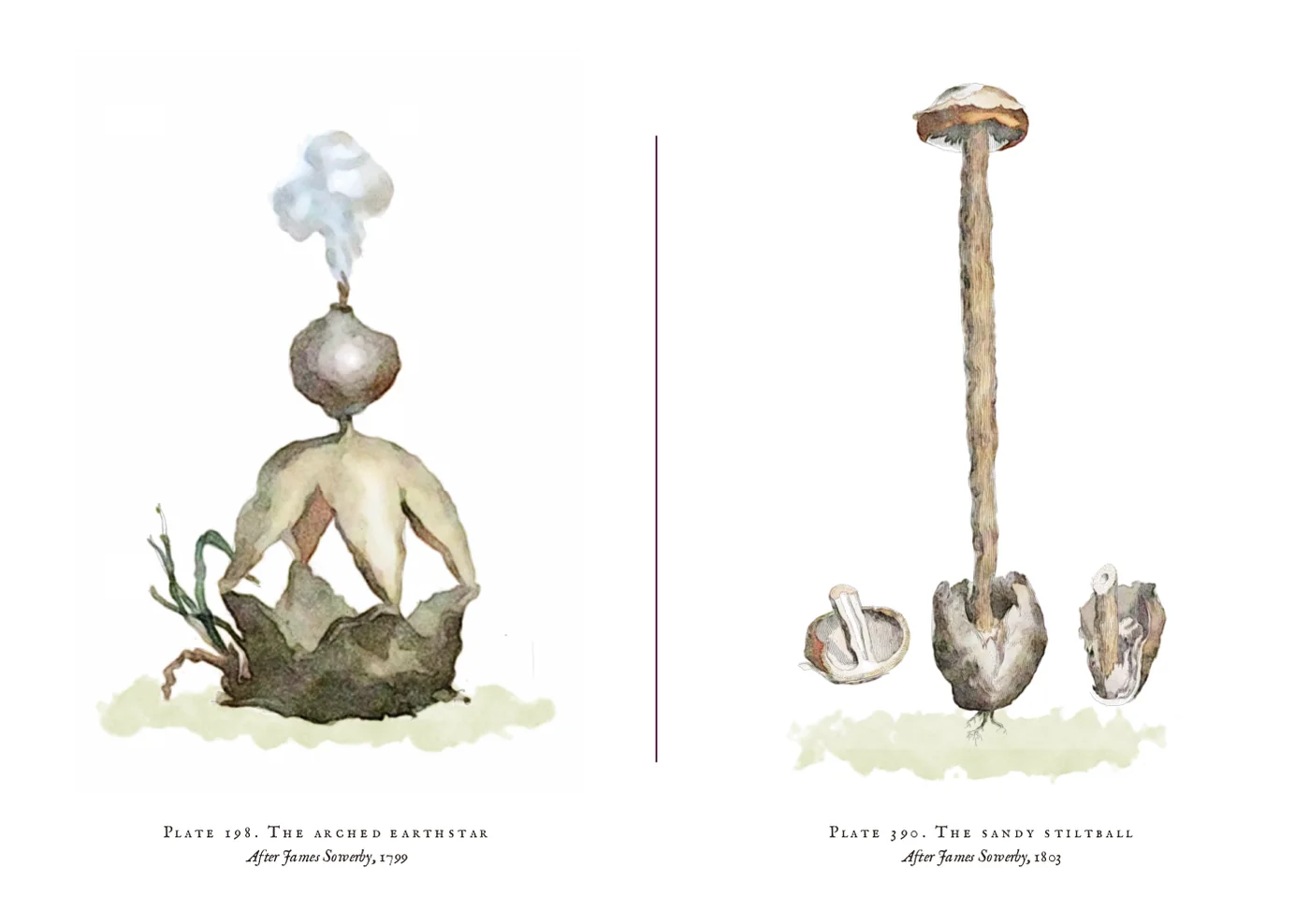
Truffles born of thunder, fairy rings you should never step inside, and the cold glow of foxfire: what people once believed about fungi, and what they turned out to be. Neither plant nor animal, and closer to animals than to plants.
The arched earthstar
Geastrum fornicatum
After Sowerby, 1799
The sandy stiltball
Battarrea phalloides
After Sowerby, 1803
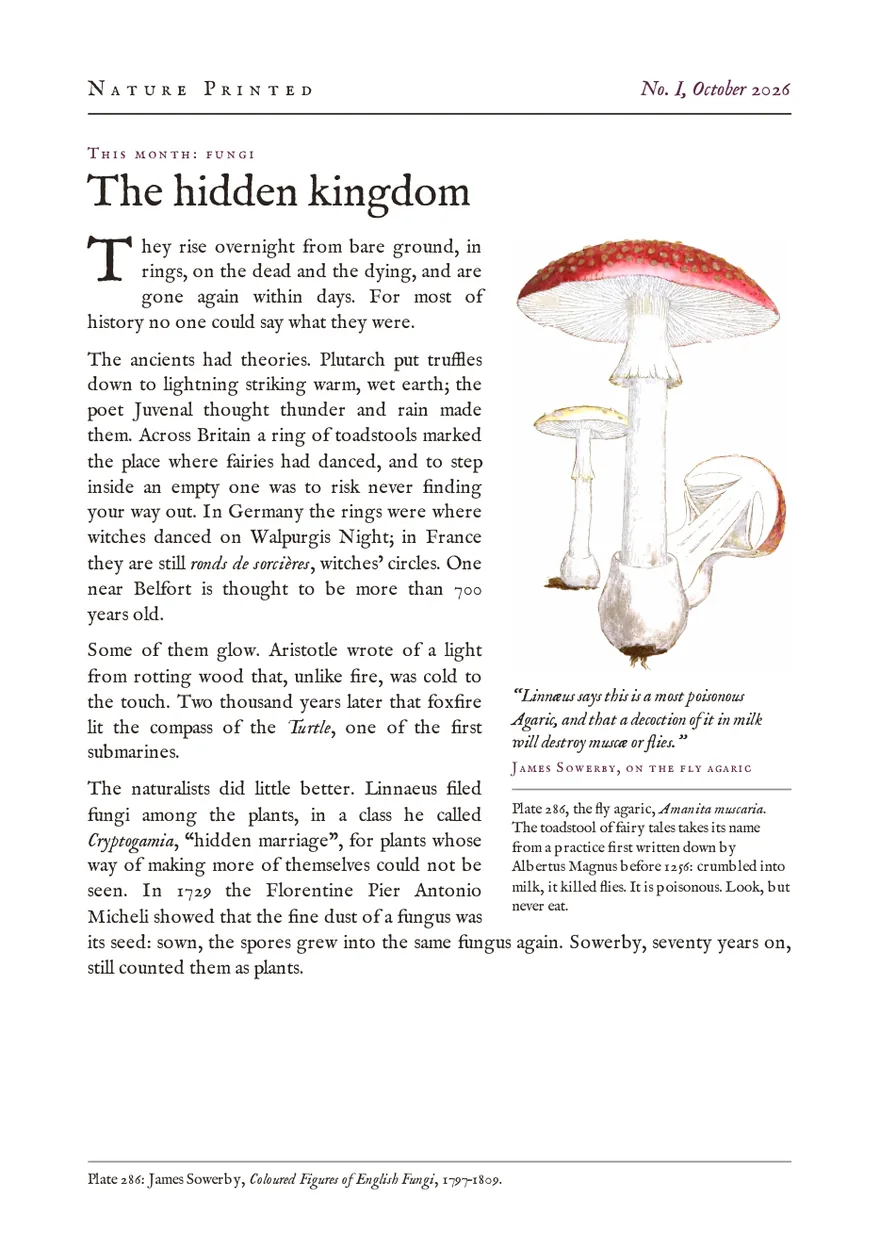
In preparation
Octopus and squid
The kraken’s kin
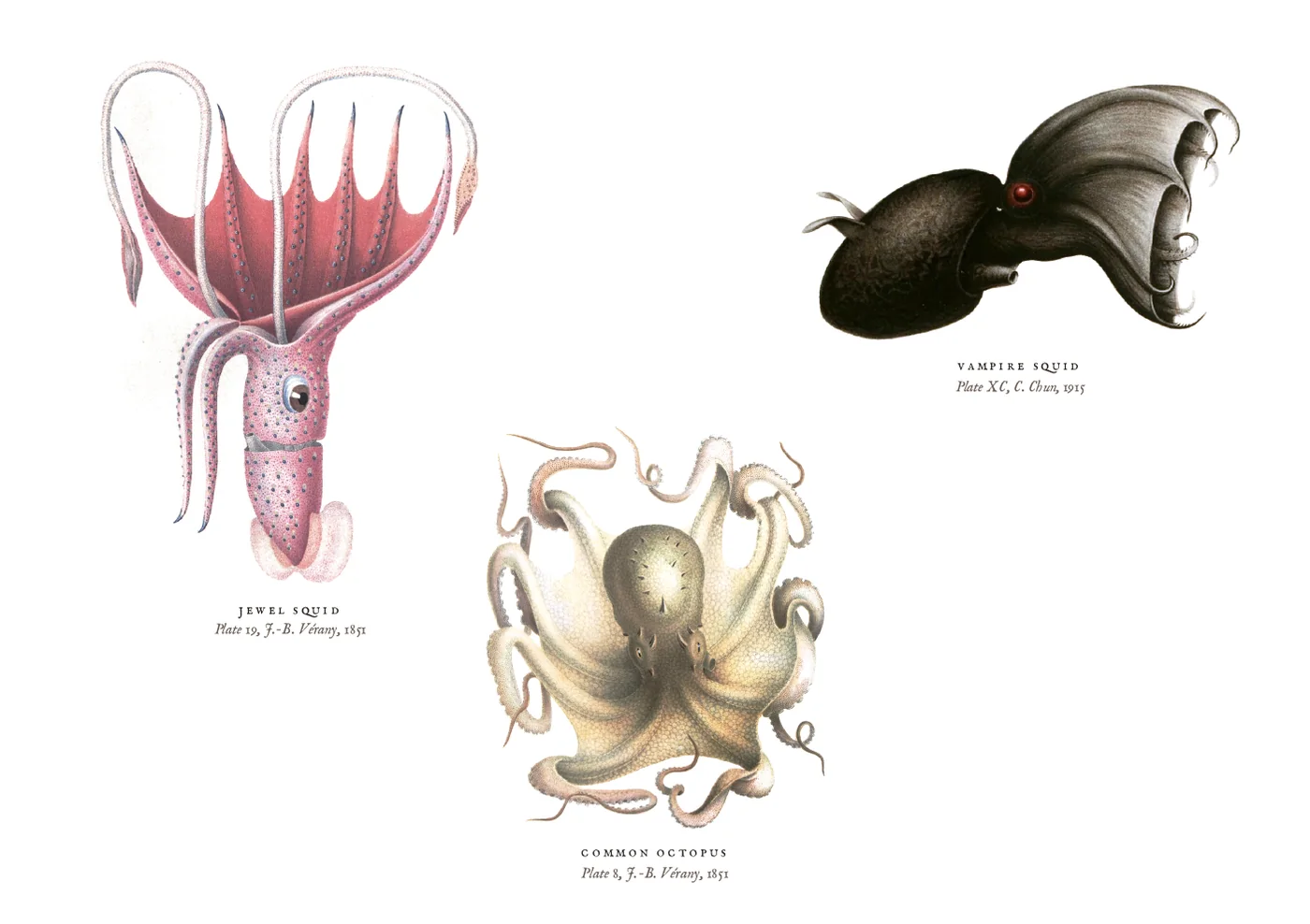
Pliny’s octopus that crept out of the sea at Carteia to raid the salted fish, the kraken of Bishop Pontoppidan, and the giant squid that no one photographed alive until 2004. Three hearts, blue blood, and two thirds of an octopus’s nerve cells in its arms.
The jewel squid
Histioteuthis bonnellii
Plate 19, Vérany, 1851
The vampire squid
Vampyroteuthis infernalis
Plate XC, Chun, 1915
The common octopus
Octopus vulgaris
Plate 8, Vérany, 1851
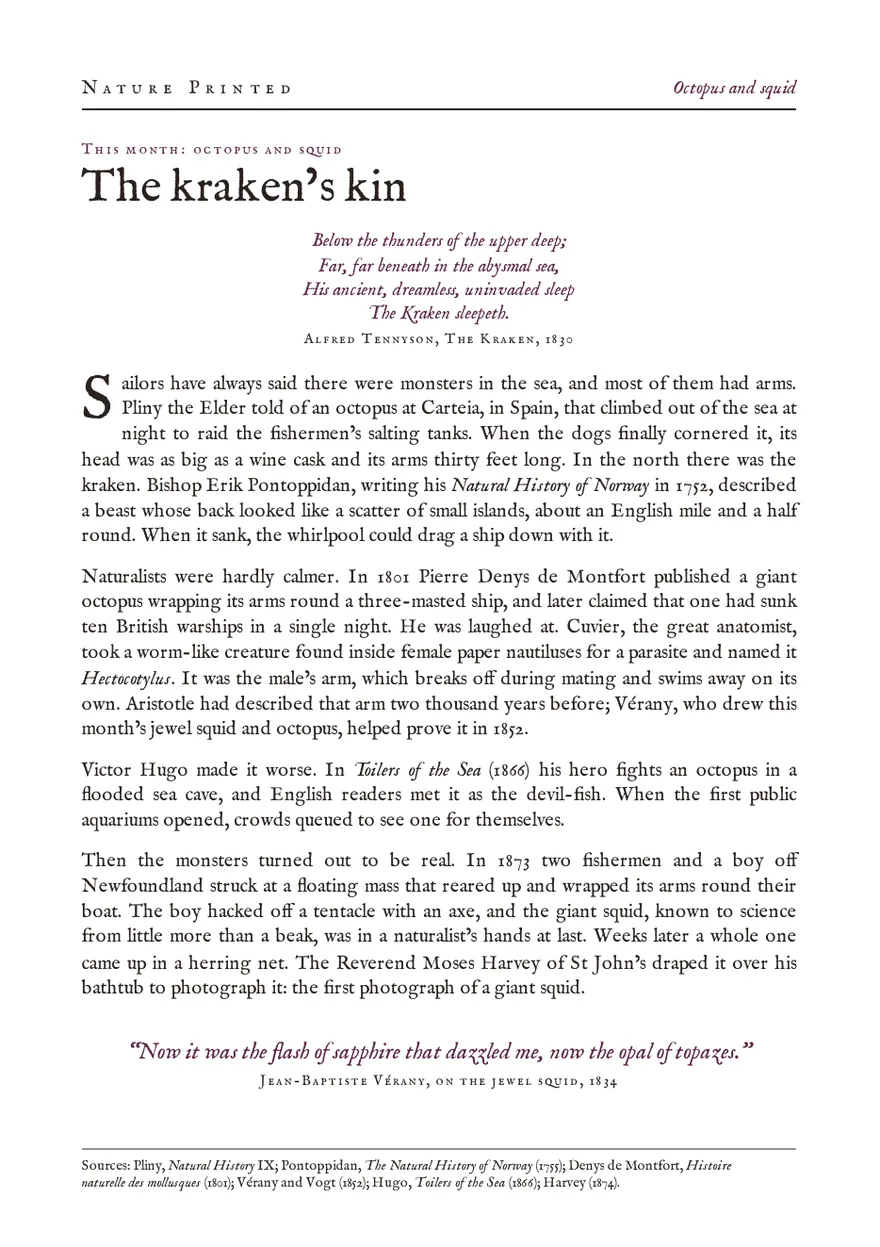
In preparation
Kingfishers
Halcyon days
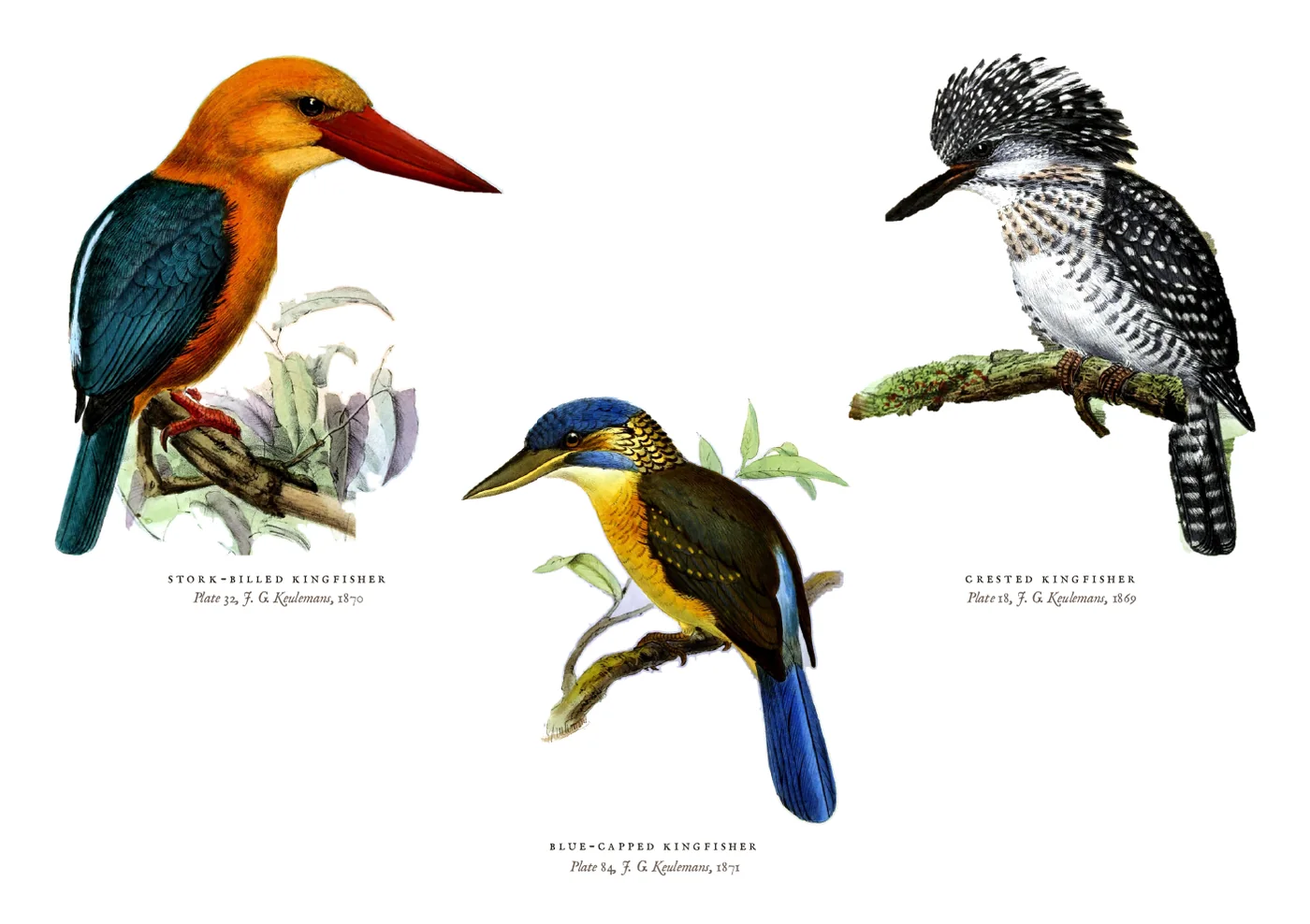
The halcyon days, when the sea was said to fall calm at midwinter so the kingfisher could nest on it; the dead kingfisher hung up to show which way the wind blew; and Richard Bowdler Sharpe, who began his great monograph at seventeen. And why many kingfishers never fish at all.
The stork-billed kingfisher
Pelargopsis capensis
Plate 32, Keulemans, 1870
The crested kingfisher
Megaceryle lugubris
Plate 18, Keulemans, 1869
The blue-capped kingfisher
Actenoides hombroni
Plate 84, Keulemans, 1871
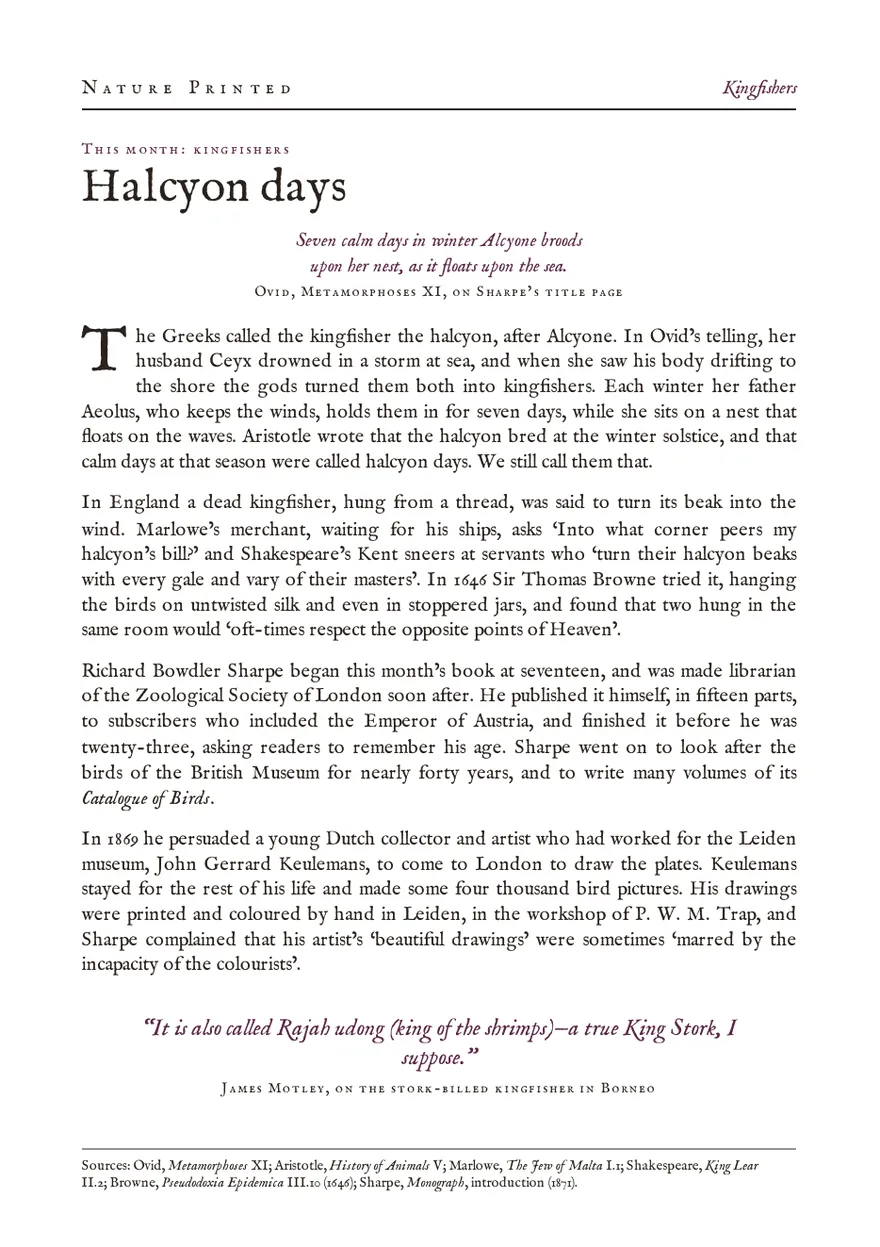
In preparation
Shells
The trumpet and the purple
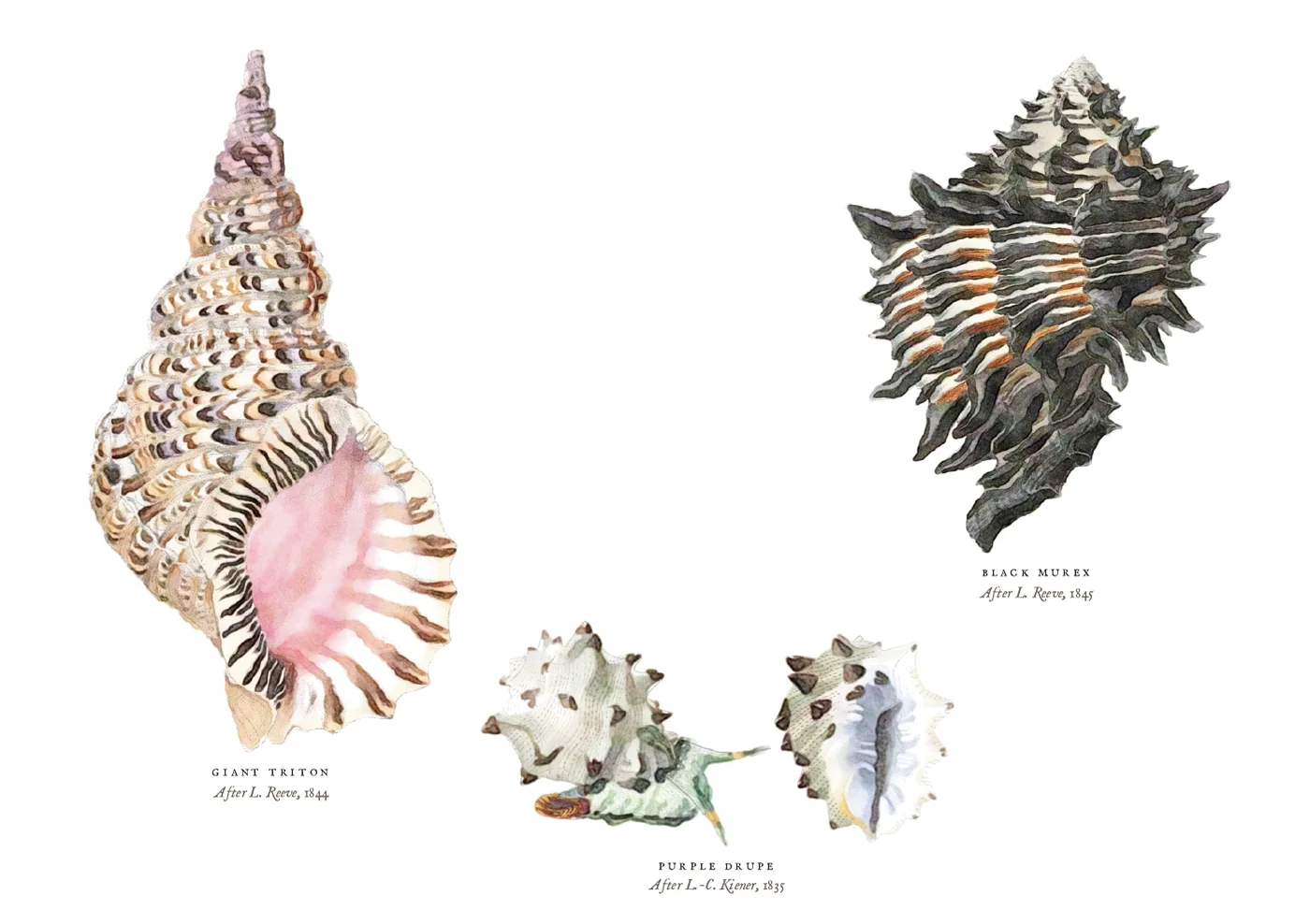
A triton-shell horn 18,000 years old, played again in 2021; the purple of emperors, drawn drop by drop from sea snails; the shell cabinets of Dutch collectors. And how a snail builds a house that grows with it.
The purple drupe
Drupa morum
After Kiener, 1835
The black murex
Hexaplex nigritus
After Reeve, 1845
The giant triton
Charonia tritonis
After Reeve, 1844
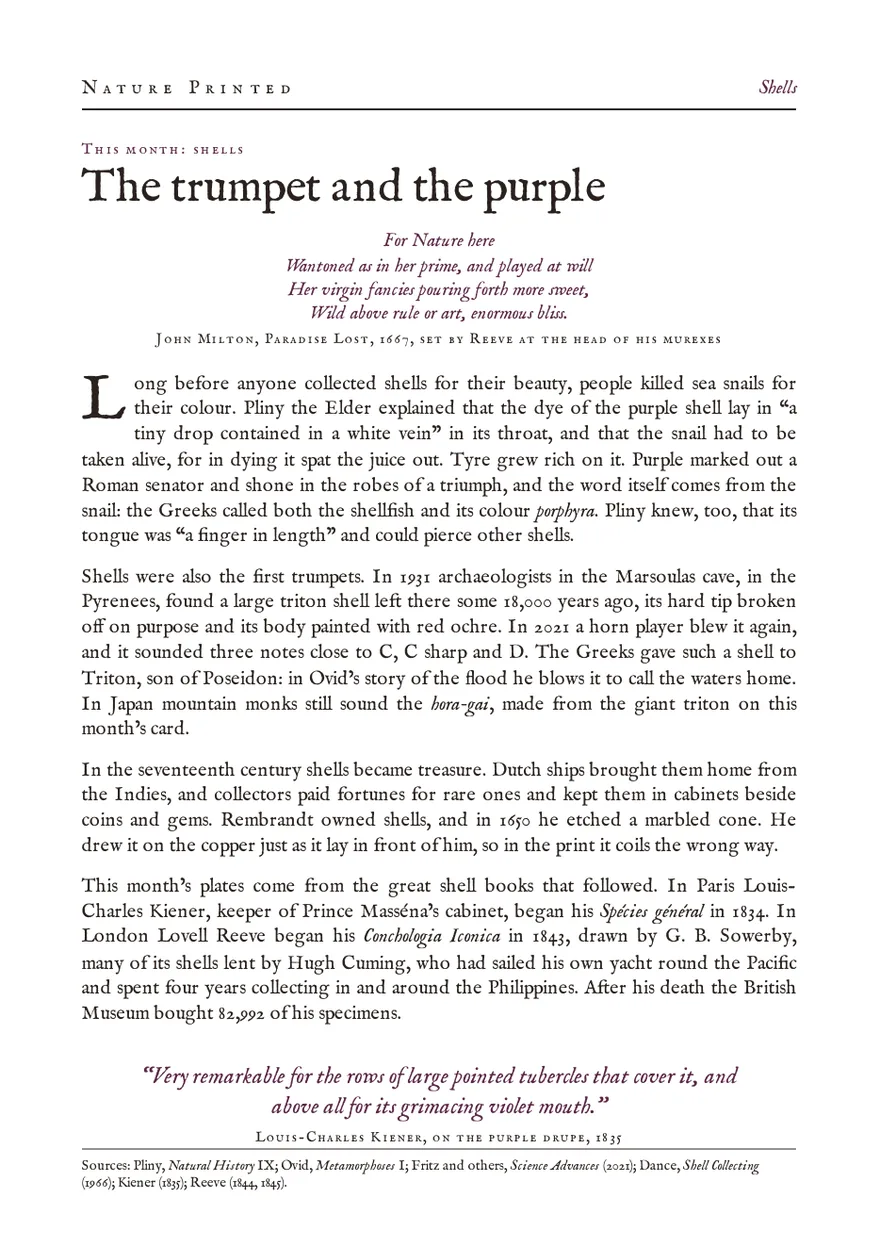
In preparation
Beetles
Scarabs, stags and Goliaths
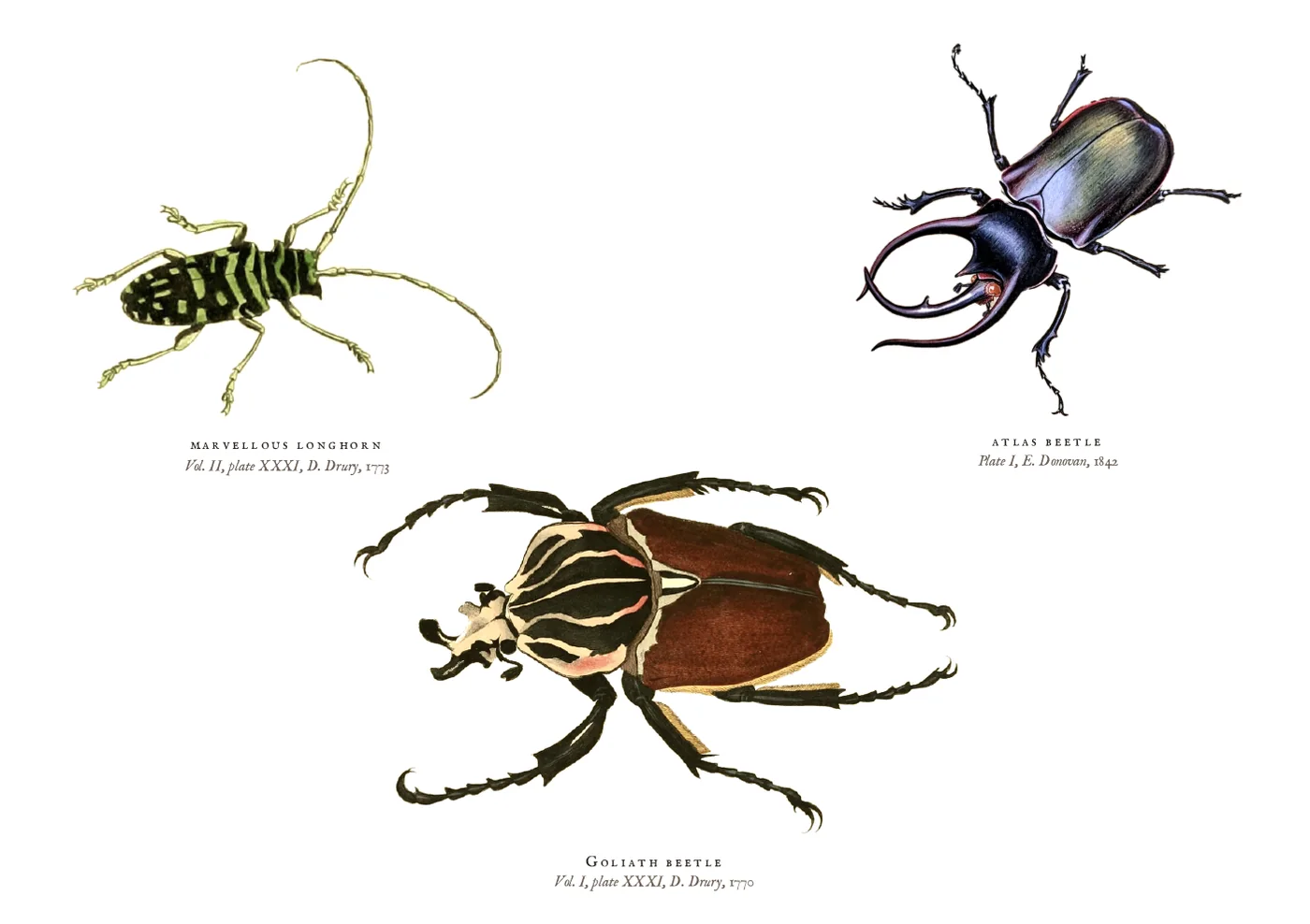
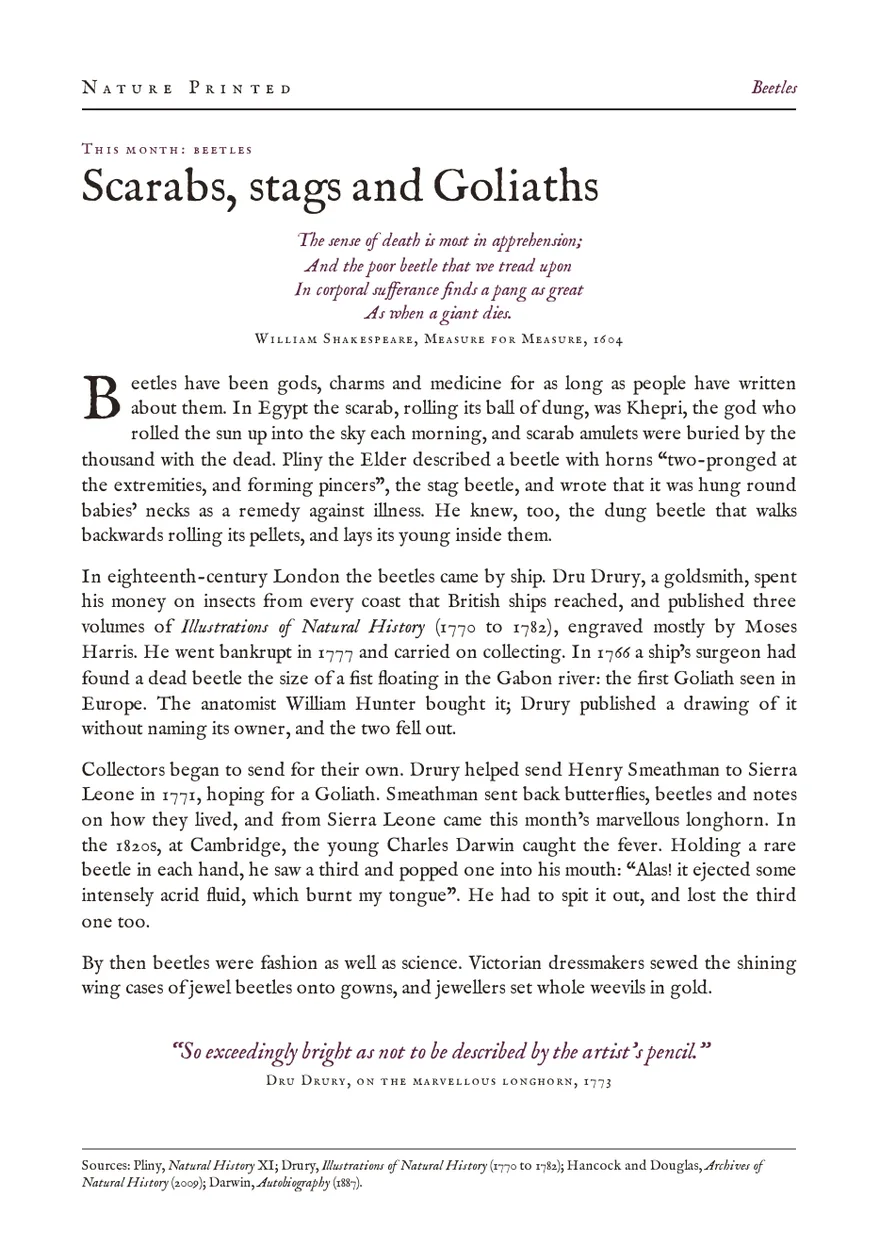
Khepri, the scarab who rolled the sun across the sky; Pliny’s stag beetles hung round babies’ necks; the first Goliath beetle, found floating dead in an African river; and the young Darwin with a beetle in his mouth. One in every four known animal species is a beetle.
The Goliath beetle
Goliathus goliatus
Vol. I, plate XXXI, Drury, 1770
The marvellous longhorn
Sternotomis mirabilis
Vol. II, plate XXXI, Drury, 1773
The atlas beetle
Chalcosoma atlas
Plate I, Donovan, 1842
In preparation
Orchids
Orchid fever
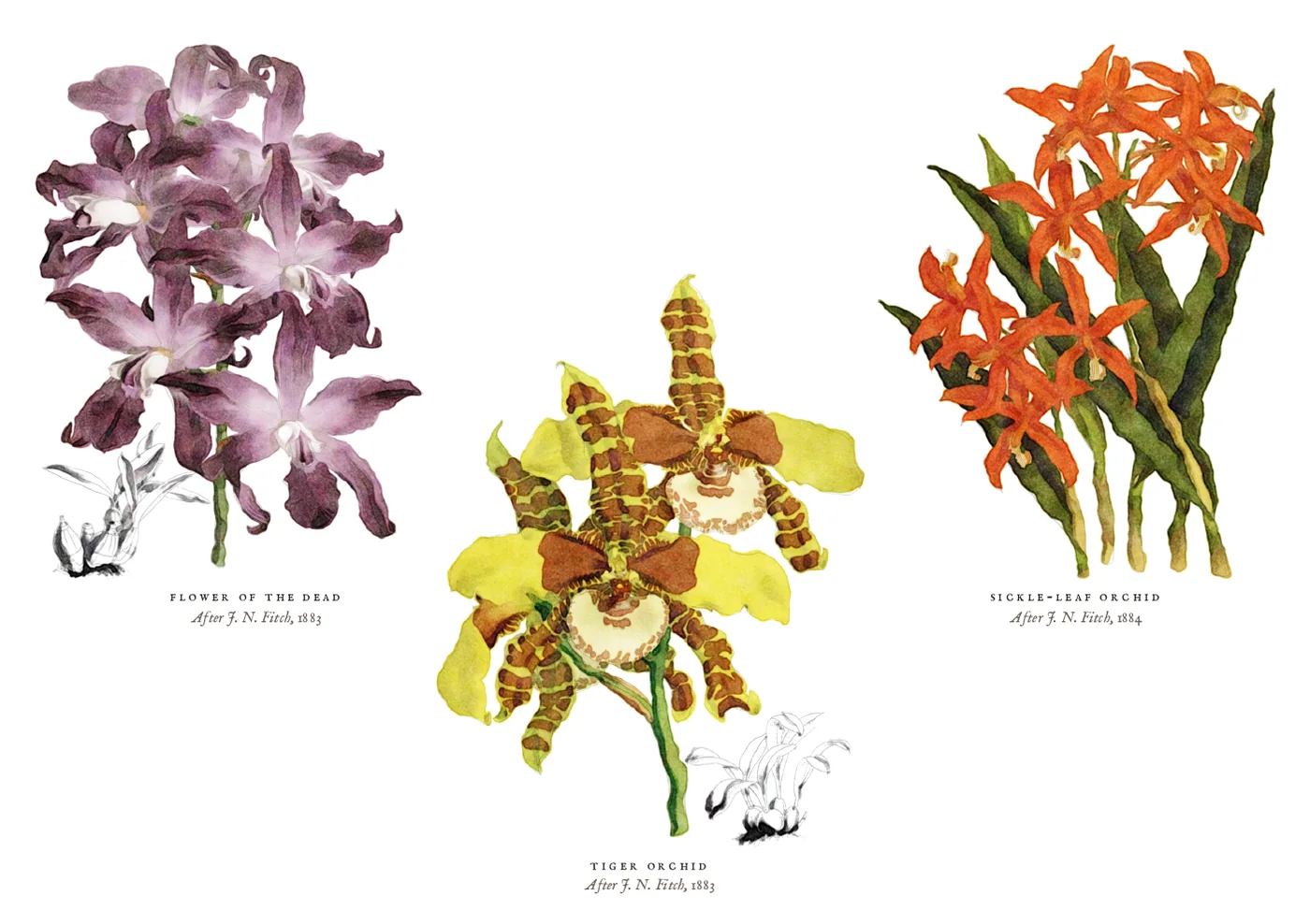
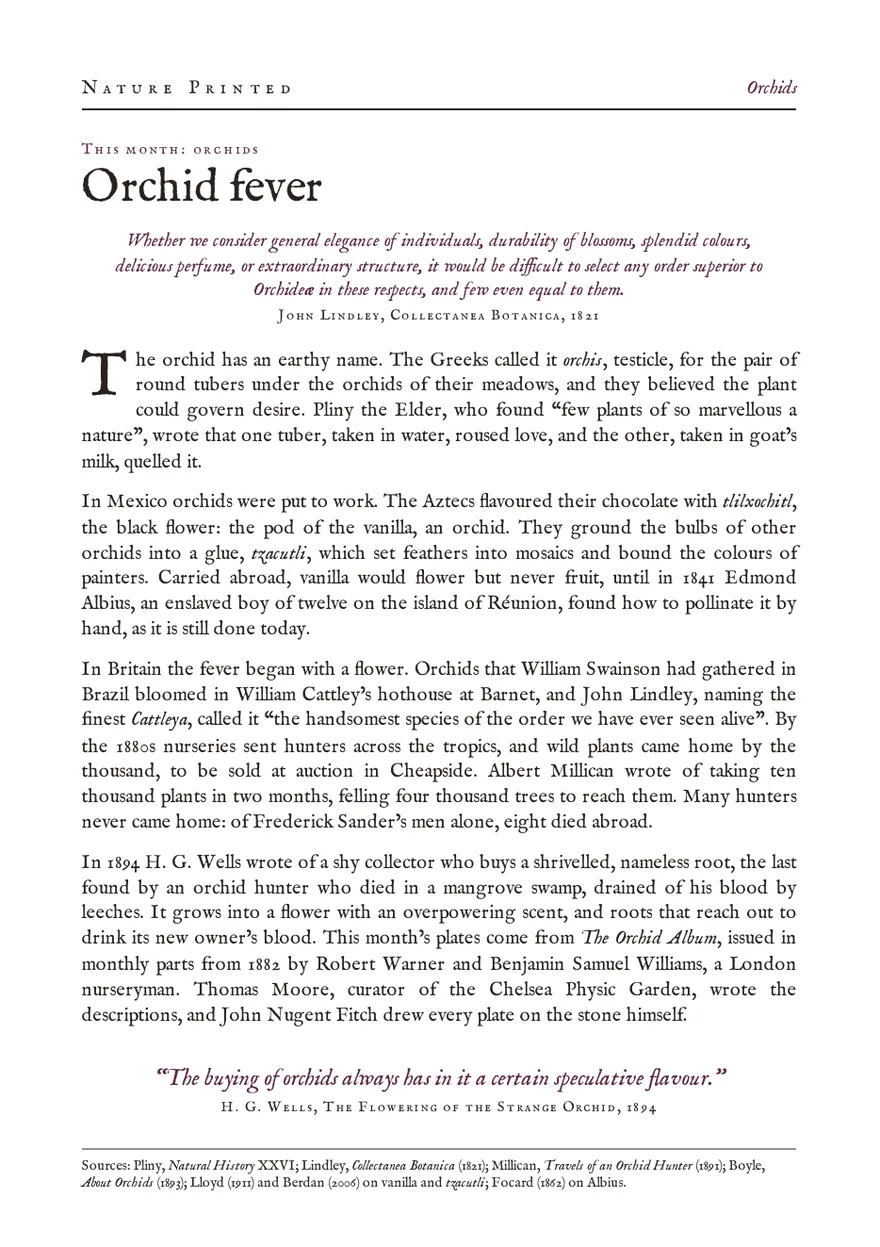
Victorian orchid fever: plants sold at auction in Cheapside, collectors who died abroad hunting them, and H. G. Wells’s blood-drinking orchid. Seed as fine as dust, the moth Darwin predicted before anyone had seen it, and the many orchids that trick their pollinators.
The flower of the dead
Laelia autumnalis
After Fitch, 1883
The tiger orchid
Rossioglossum grande
After Fitch, 1883
The sickle-leaf orchid
Cattleya harpophylla
After Fitch, 1884
Further ahead
Still in the notebook
Families we’re looking at for later issues: hummingbirds, birds of paradise, parrots, pheasants, pigeons and doves, crabs, sea slugs, deep-sea fish, corpse flowers, water lilies, cacti, moths and spiders.
Which would you open first? Write to [email protected].
Subscribe
Nature Printed, posted to you each month
- US$10 a month, postage included.
- Founding offer: 15% off your first issue for the first 20 subscribers, until 15 November. It comes off automatically at checkout.
- You pay when you subscribe, then on the same date each month.
- Issues post in the last week of each month. Subscribe by the 20th to get that month’s issue.
- Cancel any time in your account. No more payments are taken, and you still get any issue you’ve paid for.
Payment is taken securely by Stripe. By subscribing you agree to our terms of sale, which include your right to cancel in the first 14 days.
Already subscribed? Manage your subscription.
Not ready yet?
Leave your email and we’ll write when each new issue is on its way, with a look at the species inside.